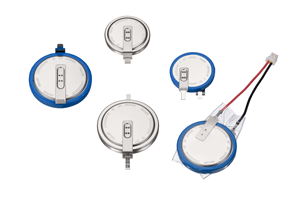
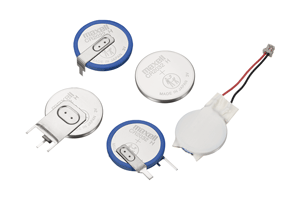
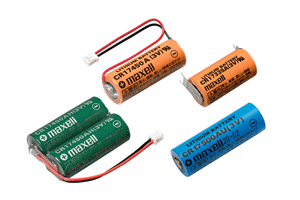
ER (Lithium Thionyl Chloride Battery)
The inquiry about this product
Overview
This battery is ideal for such long-term applications as power for electronic devices and electric power, water, and gas meters, and especially as a backup power source for memory ICs.
Features
•High 3.6-V voltage
The lithium thionyl chloride battery achieves a high voltage of 3.6 V.
•Flat discharge characteristics
The change of internal resistance during discharge is minimal, allowing for flat discharge voltage until end of discharge life.
•High energy density
Provides high energy density of 970m Wh/cm3 with discharge current of 100 µA (ER6 type).
•Wide usable temperature range
Can be used over a wide temperature range : - 55 deg. C to +85 deg. C (please consult with Maxell
if using in temperatures of -40 deg. C or less).
•Superior long-term reliability
The extremely low self-discharge, together with the use of a hermetic seal, allows for stable use
over long periods.
•UL (Underwriters Laboratories Inc.) recognized component
Product list
| Model | Nominal Voltage (V) | Nominal Capacity (mAh)*2 | Nominal Discharge Current (µA) | Operating Temperature Range (deg. C) |
Dimensions*1 |
Weight (g)*1 | Data Sheets | With terminals |
Warnings | |
|---|---|---|---|---|---|---|---|---|---|---|
| Diameter (mm) | Height (mm) | |||||||||
| ER18/50 | 3.6 | 3,650 | 125 | -55 to +85 | 18 | 52.6 | 22 | 456KB |
464KB |
792KB |
| ER17/50 | 3.6 | 2,750 | 125 | 17 | 52.6 | 20 | 520KB |
416KB |
||
| ER6 | 3.6 | 2,000 | 100 | 14.5 | 53.5 | 15 | 520KB |
416KB |
||
| ER6C | 3.6 | 1,800 | 100 | 14.5 | 51 | 15 | 520KB |
432KB |
||
| ER17/33 | 3.6 | 1,600 | 75 | 17 | 35 | 13 | 520KB |
432KB |
||
| ER3 | 3.6 | 1,100 | 40 | 14.5 | 29.9 | 8 | 496KB |
464KB |
||
| ER3S | 3.6 | 790 | 35 | 14.5 | 26 | 7 | 448KB |
464KB |
||
*1 Dimensions and weight are for the battery itself, but may vary depending on the shape of terminals or other factors.
*2 Nominal capacity indicates duration until the voltage drops down to 3.0V when discharged at a nominal discharge current at 20 deg. C.
Maxell ER (lithium thionyl chloride) batteries are available only for equipment manufacturers as a built-in part. Therefore, Maxell does not supply these batteries for replacement directly to users of equipment with these batteries. When built-in ER batteries need to be replaced, please contact your equipment manufacturer. If you are planning to use Maxell ER batteries in your equipment as a built-in part, please contact Maxell.
Maxell ER batteries are not general use products. Improper usage may cause not only poor performance but it may also damage the equipment and/or the human body. Therefore, Maxell sells ER batteries only after confirmation of the usage conditions and scope of warranty within the specifications sheet. Maxell does not guarantee the performance and quality of batteries purchased without agreement of the specifications sheet.
Construction
Principle and Reactions
The lithium thionyl chloride battery uses liquid thionyl chloride (SOCL2) as its positive active material, and lithium (Li) as its negative active material. The reactions of the battery are shown below.
| Positive reaction : | 2SOCl2+4Li++4e- -> 4LiCl+S+SO2 |
|---|---|
| Negative reaction : | Li -> Li++e- |
| Total reaction : | 2SOCl2+4Li -> 4LiCl+S+SO2 |
Minimum Transient Voltage
The lithium thionyl chloride battery has remarkably lower self-discharge when compared with conventional batteries. This is because a lithium chloride membrane is formed over the negative lithium surface, blocking reaction with the positive material. When first discharging after storage, resistance from this lithium chloride membrane may temporarily reduce the voltage at the initiation of discharge. The lowest voltage at this time is called minimum transient voltage, and the lower the temperature, and the larger the discharge current, the lower the voltage will be. Because minimum transient voltage is greatly influenced by storage time and conditions, it is necessary to take this into sufficient consideration when designing a device.
The figure above shows minimum transient voltage using a fresh battery.
Relationship between Discharge Load and Operating Voltage
The operating voltage of a battery falls as the discharge load increases and temperature falls. In the case of initial use, an electric potential of at least 3 V will be maintained even at temperatures of -40 deg. C at discharge of less than 1 mA.
Storage Characteristics
The lithium thionyl chloride battery is made from chemically stable inorganic materials. Additionally, a sealing method employing a laser-welded seal structure and hermetic seal hinders the admittance of outside air. These features provide superior storage characteristics, holding down self-discharge to no more than 1% of capacity per year at normal temperatures.
UL Recognized Components
The lithium thionyl chloride battery is a UL (Underwriters Laboratories Inc.) recognized component.
(Technician replaceable)
Recognized models: ER18/50, ER17/50, ER6, ER6C, ER17/33, ER3, ER3S
Certification number: MH12568
Applications
●OA Machines (Fax, Copiers, Printers)
●Desktop PCs ●PDAs
●Medical Instruments, Cash Registers
●FA Instruments (Measuring Instruments, Onboard Microcomputers, Sensors)
●Electronic Meters (Gas, Water, Electricity)
●ETC (Electronic Toll Collection System)
• Data and dimensions are not guaranteed. For further details, please contact us at your nearest Maxell office.
• Contents on this website are subject to change without notice.
- Q1: Primary battery
-
A1:
Source of electrical energy obtained by the direct conversion of chemical energy and not designed to be charged by any other electrical source.
- Q2: Rechargeable battery (Secondary battery)
-
A2:
Source of electrical energy obtained by the direct conversion of chemical energy designed to be charged by any other electrical source. It is also called a storage battery or accumulator.
- Q3: Open circuit voltage (OCV)
-
A3:
Voltage across the terminals of a battery when no external current is flowing.
- Q4: Closed circuit voltage (CCV)
-
A4:
Voltage across the terminals of a battery when it is on discharge.
As a battery has an internal resistance, CCV is lower than OCV and CCV becomes lower with a range of current. - Q5: Nominal voltage
-
A5:
Suitable approximate value of voltage used to identify the voltage of a battery.
For example) Alkaline manganese battery; 1.5V
Lithium manganese dioxide battery; 3.0V
- Q6: Load
-
A6:
External device or method through which a battery is discharged.
- Q7: End-point voltage (End voltage, Cutoff voltage, Final voltage)
-
A7:
Specified closed circuit voltage at which a service output test is terminated.
- Q8: Internal resistance
-
A8:
Resistant component in a battery that makes discharge reaction slow.
- Q9: Discharge
-
A9:
Operation during which a battery delivers current to an external circuit.
- Q10: Over discharge
-
A10:
Continue to discharge after a battery voltage drops below its end-point voltage.
- Q11: Self discharge
-
A11:
Decreasing capacity during storage without load, caused by chemical reaction in a battery. The higher the temperature during storage, the greater the rate of self discharge.
- Q12: Discharge characteristics (Discharge curve)
-
A12:
Change of a battery voltage with discharge.
- Q13: Charge
-
A13:
Operation during which a reverse reaction of discharge occurs when electrical energy is received from an external source.
- Q14: Polarization
-
A14:
Voltage deviation from equilibrium caused by charge or discharge.
- Q15: Duration time (Duration period)
-
A15:
Time until a battery voltage exceeds the end-point voltage during discharge.
- Q16: Capacity
-
A16:
Capacity (Ah, mAh) is the product of the discharge current (A, mA) and discharge time (h).
Note: Because manganese dry batteries and alkaline manganese batteries are often used for heavy-duty applications, the discharge time at a specific load is usually mentioned instead of the capacity. - Q17: Energy Density
-
A17:
Usable energy of a battery per unit volume or unit weight. The former is called volumetric energy density (Wh/l); the latter gravimetric energy density (Wh/kg).
- Q18: Initial test
-
A18:
Test conducted within 2 months of the production month.
- Q19: Storage
-
A19:
Store the battery under specified conditions.
- Q20: Test after storage
-
A20:
Test conducted within 2 weeks after storage.
- Q21: Aging
-
A21:
A finished or semi-finished battery is store under specified conditions for a specified period.
- Q22: Expiry date
-
A22:
Expiration of guarantee period of a primary battery determined by each manufacturer conforming to the IEC. Because a secondary battery can be used over again by charging, it is unnecessary to show this.
Note: IEC (International Electrotechnical Commission) is a worldwide organization of standardization comprised of all national electrotechnical committees. - Q23: Active material
-
A23:
Electrode materials in a battery which cause an electrochemical reaction to generate electricity.
Ex) Battery Positive material Negative material
LR Manganese Dioxide Zinc
CR Manganese Dioxide Lithium - Q24: Electrolyte
-
A24:
Medium in a battery which causes ions to move to create an electrochemical reaction. Either water or non-aqueous solution is used as solvent. The latter is called non-aqueous electrolyte solution, either organic or inorganic.
- Q25: Utilization factor
-
A25:
Ratio of usable capacity against theoretical capacity.
- Q26: Leakage resistance
-
A26:
Enduring characteristics against leakage.
- Q27: Short circuit current
-
A27:
Surges of current across the terminals of a battery when it is short-circuited.
- Q28: Internal short circuit
-
A28:
Direct contact electrically between the positive electrode and negative electrode caused by damage to the separator or gasket, or the presence of a conductor piercing the separators. A battery will become completely exhausted before use.
The inquiry about this product

- ・Core Battery Technologies

Materials/Parts

Wellness, Beauty Care & Medical
Materials/Parts

Construction & Civil Engineering
Materials/Parts